Modern Frontend Development with Laravel, Livewire, Vue.js and Alpine.js
Understand the differences between Livewire, Vue.js and Alpine.js, and learn how to choose the right frontend architecture for Laravel applications.
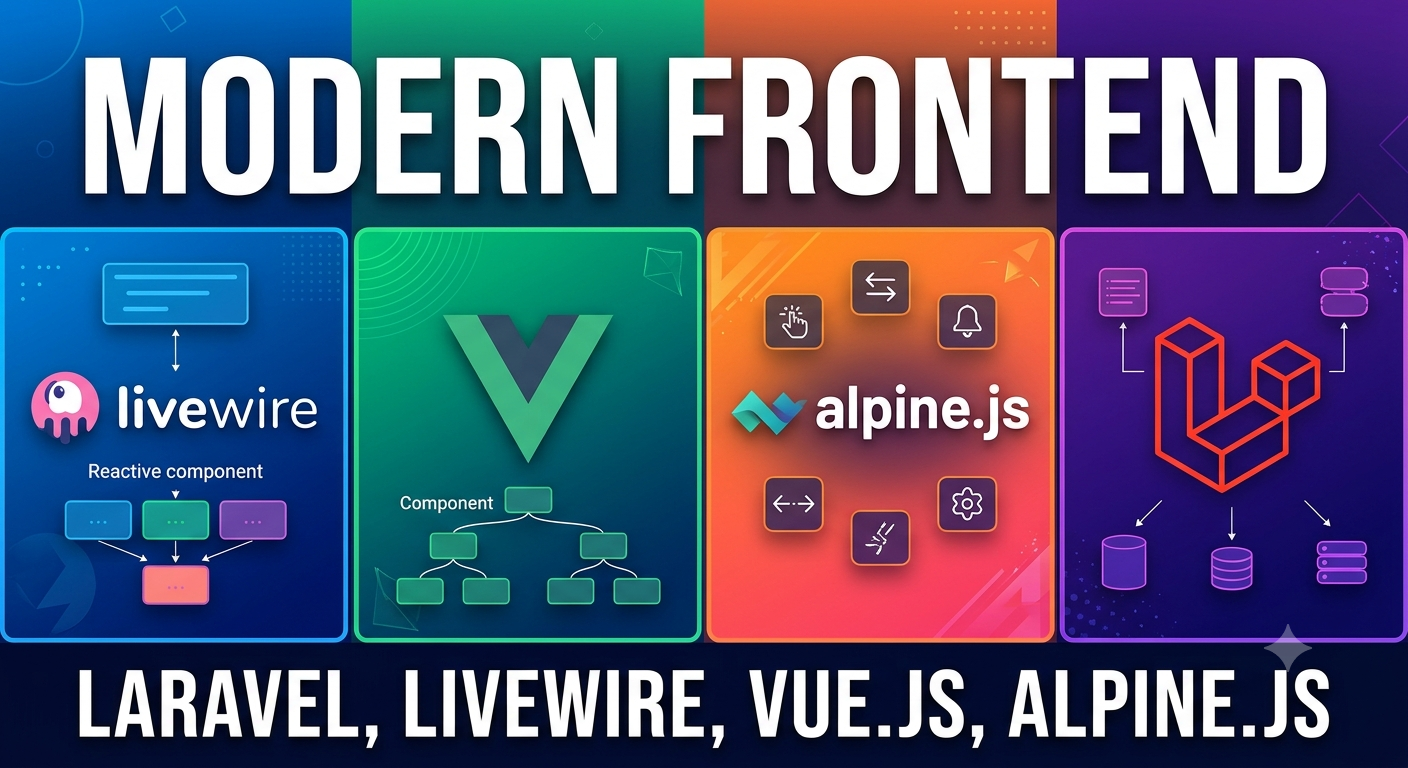
Introduction
Frontend architecture plays an important role in the performance, maintainability and user experience of a web application.
Laravel developers have several options for building interactive interfaces, including server-driven rendering with Livewire, lightweight interactions with Alpine.js and component-driven frontend applications with Vue.js.
These technologies solve different problems. Choosing between them should depend on the complexity of the interface, application requirements and the team's development approach.
1. Laravel Blade: A Strong Starting Point
Blade is Laravel's server-side templating engine. It provides layouts, components, directives and convenient integration with application data.
For many websites and business applications, Blade is sufficient for rendering pages and managing reusable interface elements.
It can also be combined with JavaScript libraries when individual parts of the interface need additional interactivity.
2. Livewire for Server-Driven Interactivity
Livewire allows developers to build interactive Laravel interfaces using PHP components and server-side application logic.
It is useful for forms, search interfaces, filters, pagination and business workflows where developers prefer to keep much of the application logic in Laravel.
For example, an inventory management application can use Livewire to search products, update quantities and refresh relevant interface sections without implementing a completely separate frontend API architecture.
Developers should still consider network requests, component lifecycle behavior and the amount of data transferred during updates.
3. Alpine.js for Lightweight Interactions
Alpine.js is a lightweight JavaScript framework that provides declarative behavior directly in HTML.
It works well for interactions such as dropdown menus, modals, tabs, toggles and small interface state changes.
It is particularly useful when the application already uses Blade and does not need a large frontend framework for every interaction.
Alpine.js can complement Livewire, but state ownership should be clearly defined to avoid synchronization problems.
4. Vue.js for Rich Frontend Applications
Vue.js is a progressive JavaScript framework designed for building component-based user interfaces.
It is useful when an application requires more complex client-side interactions, reusable frontend components, sophisticated state management or a dedicated frontend experience.
For example, a data-heavy reporting interface or a complex interactive dashboard may benefit from Vue.js.
Vue can work with Laravel through API endpoints, Inertia or other integration approaches depending on the application's architecture.
5. How to Choose the Right Technology
Choose Blade when:
The application primarily renders server-side pages.
Interactions are limited.
You want a straightforward Laravel architecture.
Choose Livewire when:
You need interactive business forms and tables.
Most application logic belongs in Laravel.
You want to build dynamic interfaces using PHP components.
Choose Alpine.js when:
You need small frontend interactions.
You want lightweight JavaScript behavior.
You are extending Blade-based interfaces.
Choose Vue.js when:
You need complex client-side application behavior.
You want reusable JavaScript components.
You are building a richer SPA-style experience or a dedicated frontend.
6. Why Database Performance Still Matters
A responsive frontend cannot compensate for inefficient backend queries.
When building interactive applications, every search, filter and component update can trigger database activity.
MySQL performance should therefore be considered alongside frontend architecture.
Useful practices include:
Index columns used frequently in filters and joins.
Use eager loading where relationships are required.
Avoid retrieving unnecessary columns.
Paginate large collections.
Inspect slow queries and execution plans.
Cache expensive computations when appropriate.
7. Avoid Unnecessary Technology Complexity
Using every available frontend framework in one application does not automatically improve the user experience.
Mixing Livewire, Alpine.js and Vue.js without clear boundaries can introduce duplicated state, unnecessary JavaScript and more complicated maintenance.
Choose a primary approach for each application or interface area and introduce additional technologies only when they solve a genuine problem.
Conclusion
Laravel, Livewire, Alpine.js and Vue.js provide different ways to build modern web applications.
Blade and Livewire can be effective for server-driven business applications, Alpine.js is useful for lightweight interactions, and Vue.js offers greater flexibility for complex client-side interfaces.
The right choice is the one that satisfies application requirements while keeping the architecture understandable and maintainable.
Planning a custom web application? LaraMasters works with Laravel and modern frontend technologies to build scalable business applications and tailored software solutions.